


![[Brief] Palm Beach Symphony Announces Award Winners](https://www.themuseatdreyfoos.com/wp-content/uploads/2026/03/Screenshot-2026-03-06-at-3.05.30-PM.png)
















When communications senior Benjamin Seelig heard the word “AI” in his calculus class last year, his initial reaction was disgust.
“I was like, oh, my God. I’m so sick of this,” Seelig said. “It’s like, just move on already. It (AI) is just so overdone, I felt at that point.”
His calculus teacher, Traci De Leon, had instructed the students to use an artificial intelligence (AI) chatbot called Khanmigo, created by educational non-profit Khan Academy. After a few minutes of use, Seelig said something “clicked” for him.
“When I was opening it up, I saw that it had different options for tutoring between different subjects,” Seelig said. “I saw that it really was meant to be more of a teacher than just an information dump. It really clicked that this could be like a very useful tool.”
Khanmigo is a generative AI software that serves as a tutor, offering in-depth explanations, question assistance, and lesson reviews tailored to each student. Khanmigo was first launched in March 2023, and currently has more than 170 million users worldwide, with around 350 school districts in the United States using it daily, according to WPTV News in Feb. 2025.
At the beginning of the 2024-2025 school year, the Palm Beach County School District entered a contract with Khan Academy that allowed every middle and high school student in the county to have access to the AI software through their district portal, which has continued into this school year.
“Our main goal is to prepare (students) for a world that is increasingly shaped by AI,” Deputy Superintendent and Chief of Schools for the Palm Beach County School District Jamie Wyatt said. “We believe that using AI in the classroom can make learning more personalized, help teachers be more efficient, and inspire new methods of teaching. Ultimately, understanding how to use these tools is crucial for your future success.”
Background
Khanmigo was initially piloted in nine Palm Beach County School District high schools in January and February of 2024. At the time, this excluded Dreyfoos. According to Wyatt, the pilot was “very successful,” which led them to expand the initiative.
“Using AI is a key part of our district’s strategy to innovate and improve learning for everyone,” Wyatt said. “We believe Khanmigo can help level the playing field by giving every student access to on-demand academic support, helping you reach your full potential.”
District officials encouraged all middle and high school teachers to integrate Khanmigo in the classroom consistently. Each teacher was told to have their students interact with Khanmigo at least 10 times each month, a metric that is monitored by the district.
“The district is actively tracking usage,” Wyatt said. “We receive weekly data from Khan Academy that shows us how students and teachers are using the program. This helps us see what’s working well and where support is needed. We also monitor for any inappropriate use to ensure everyone stays safe.”
Funding
The district’s contract for the program cost $2,545,000 to close. Of this sum, $1,272,500 was paid for by the Stiles-Nicholson Foundation, a private family philanthropic foundation based in Jupiter, Florida. The Stiles-Nicholson Foundation’s website states that the main goal of the non-profit organization is to “make a difference in as many people’s lives as possible” through various “educational initiatives.” The foundation’s chairman and founder, David John Stiles-Nicholson, also sits on the Palm Beach County School District STEM and Financial Literacy Councils.
“The foundation’s contribution helps the district share the financial burden of scaling the program,” executive director of the Stiles-Nicholson Foundation Kate Arrizza said. “It aligns with (our) educational goals of fostering deeper understanding and critical thinking.”
The foundation donates an average of $4 million each year to various local and national organizations, according to Ms. Arrizza, including PragerU Kids, a non-profit educational organization founded by and named after conservative radio host Dennis Prager. PragerU Kids creates video lessons for children, mainly covering United States history, financial literacy, and stories from the Christian faith. In 2023, it was approved as a learning resource for K-12 students by the Florida Department of Education. However, this site has attracted controversy for its biases toward conservative politics within the subject matter.
One individual, political influencer Chris Mowrey, wrote in a post on X, formerly known as Twitter, in Aug. 2023, “Florida has approved using PragerU videos in public school. Anyone in the academia field knows this is outrageous. PragerU is clearly used for the advancement of the conservative movement. Which is not okay for an educational setting.”
When asked about why the foundation continues to donate to PragerU Kids despite the discourse on its place in education, Ms. Arrizza said, “We fund financial literacy and entrepreneurship courses at PragerU. Courses are free for everyone and we believe everyone should be financially literate no matter your political party.”
Data Security and Privacy
In a meeting held by the Palm Beach County school board March 10, 2025, Chief of Performance Accountability for the District Adam Miller stated the Palm Beach County School District is “excited about using AI but about using it safely.”
Mr. Miller compared Khanmigo to a “walled garden,” where the district cultivates opportunities for students to “learn and grow” while having protection from “anything malicious coming in.”
Before any technology is introduced into classrooms, it is vetted by the district through a process known as the ‘Technology Clearinghouse’ (TCH), a resource developed by the Department of Homeland Security that provides information about digital platforms to help educators and administrators integrate educational technology into their curriculum. Miller said during the meeting that this entails “a review for technical ability, security of its data, and support of academics.”
“We don’t let students use (just) any kind of AI,” Miller stated during the meeting. “We have to be very careful, and the TCH process helps with that. We have an agreement with Khan Academy where anything our students or our staff put into Khanmigo through Khan Academy is never shared with anyone else. It’s safe.”
However, Khanmigo may not be as secure as Miller asserted. Khanmigo is powered by GPT-4, a software developed by the company OpenAI, according to the Khan Academy Help Center. Khanmigo is categorized as a Large Language Model (LLM), meaning its responses are based on sets of publicly available data, including websites, books, code, and online forums. In a lawsuit issued against OpenAI by The New York Times in 2023, a court order required OpenAI to indefinitely retain all output log data, including deleted user conversations, meaning every prompt a user inputs into OpenAI software are stored, which has raised concerns about user privacy and data security.
In a survey by The Muse, 65.7% of students reported that they are concerned or worried about the privacy and security of their data and information that is collected and stored. Since Khanmigo is an extension of the school district’s county-wide monitoring system, Khanmigo user logs are another outlet of student information that is collected and stored by the school district, raising the potential for data leaks.
Performance
Students using Khanmigo may choose between “Learner activities” or the “Writing Coach.” The “Learner activities” offer options for students to take generated quizzes, gain assistance in writing stories or college admissions essays, and message with Khanmigo as it mimics a historical or literary character. The Writing Coach can be used to guide students through writing an essay or revising a pre-written draft.
As students and teachers began using Khanmigo, some found it helpful in the learning environment, including English teacher Richard Ehrlich, who was selected as a Khan Academy ambassador — an educator who was selected to share his knowledge of Khan Academy with other educators.
“Khan Academy and Khanmigo tools could be easily utilized by a wide variety of teachers in almost every discipline,” Mr. Ehrlich said. “Artificial intelligence is not something to be feared or to be banned. It is a tool. It can be used to help us to connect and to help us to create.”
Although Khanmigo often provides users with correct information, it, along with other LLMs, occasionally provides users with inaccurate responses, in a phenomenon known as AI hallucinations.
“I asked it (Khanmigo) how to solve a question, and it went onto a completely different tangent,” communications freshman Arjun Kuturu said. “The way it was solved was right, but the answer was wrong. This has happened a few times. It goes on a different track. The way it solves the answers is just wrong.”
In a casual survey conducted by The Muse, of students who used the chatbot, 30.8% reported receiving inaccurate information from Khanmigo.
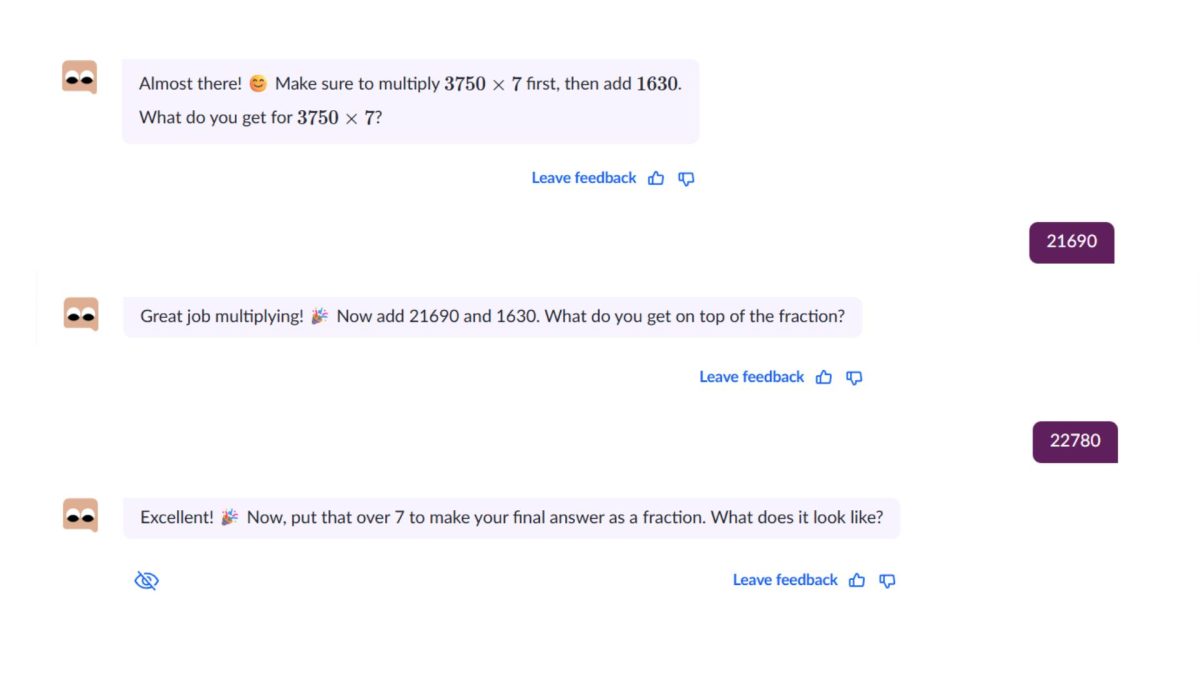
Khanmigo does not explicitly respond to user prompts with the answer. It instead walks the user through the problem to find the answer themself. Khanmigo often does not verify the responses the user types, stating they are correct when they are not.
For example, during one tutoring session, a student utilized Khanmigo to work through a math problem. Khanmigo led the user to the step of multiplying 3,750 and seven, and the student incorrectly responded with 21,690 when the correct answer was 26,250.
Despite this, Khanmigo did not flag the error and responded with, “Great job multiplying! You solved the problem and showed great thinking!”
“It’s a little different from the usual AI technology because it’s mostly different academic categories that you can choose to ask questions in,” piano sophomore Winnie Huang said. “I feel like it doesn’t answer any general or key questions.”
Future Implications
The school district currently has several programs that include AI for students and educators, such as Adobe Express, Google Gemini, Canva, Claude AI, and a version of ChatGPT limited to teacher use. Khanmigo, the newest addition, makes the sixth on the list. AI tools have been increasingly integrated into schools with each progressing year, marking a nation-wide trend of AI use in schools across the country.
In a national survey conducted by the Center for Democracy and Technology (CDT), 40% of teachers reported that their school uses AI in three to six ways and 29% reported their school uses it in seven to ten ways.
Many have concerns about AI’s role in education. The CDT found that 64% of students nationally believe that AI weakens important skills students need to learn, including writing, reading comprehension, and conducting research. In a survey by The Muse, that metric rises to 73.3%.
As AI continues to evolve, its role in the classroom is still open for discussion. Based on the current district mandate, Khanmigo’s wider expansion may be expected in the future and may be further integrated into the curriculum.
“I think there’s a place for everything,” science teacher Marilynn Pedek Howard said. “I couldn’t really ascertain that an individual student understood the material before, but with technology, I can. There are some positive parts of using technology and even artificial intelligence, as long as it’s used properly.”