![[Brief] Palm Beach Symphony Announces Award Winners](https://www.themuseatdreyfoos.com/wp-content/uploads/2026/03/Screenshot-2026-03-06-at-3.05.30-PM.png)
















The crack of a starter pistol sends runners flying down the track during meets, while other competitors hurl discuses through the air that soar above the ground as the crowd roars. For the track team, every event highlights a different skill, demanding drive and determination to see who comes out on top. Here’s a quick breakdown of some of those events, such as running, relay, and the discus throw for those who may not know much about the sport.
Running Events: Sprints and Endurance Runs
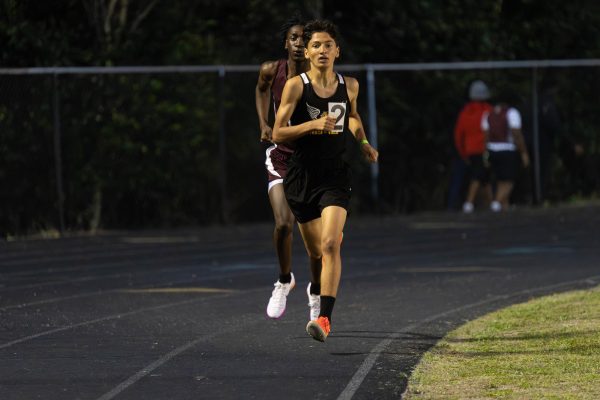
There are two main categories of individual running events: short distance events known as sprints, with distances of 100 meters (m), 200m, and 400m, and mid to long distance endurance events, such as the 800m, 1600m, and the 3200m. Sprints require fast acceleration and speed from start to finish, with runners typically finishing in under a minute, while longer distance events prioritize endurance. Mid-distance events like the 1600m mix “both speed and endurance,” according to visual junior Max Cannon.
“(The 1600m) is longer than a sprint, so you can’t go all out at the start, but it’s shorter than long-distance races, so you still have to keep a strong pace,” Cannon said.
With the 1600m event being described as “intense” and “strategic” by Cannon, it requires competitors to run four full laps around the 400m long running track. For comparison, the average football field is around 110 meters long, meaning that the average running track is about the length of four football fields. Other events like the 800m take two laps, and the 3200m, takes eight laps.
“The one thing that pushes me to train is having a strong rival to push me harder, and make my workouts more intense,” Cannon said.
Relay Events
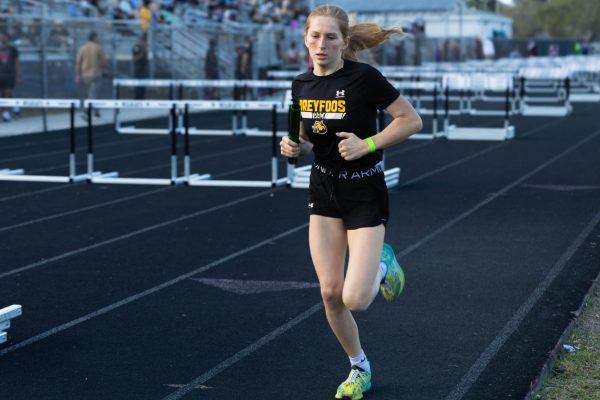
Relay events in track and field feature three main distances: the 4x100m, 4x400m, and the 4x800m relays. Each event requires teams of four people for both the boys and girls races. The first team to have their final member cross the finish line wins.
The relay event requires each runner on the team to run the same distance on a track: 100 meters for the 4x100m, 400 for the 4x400m, and 800 for the 4x800m. Each runner on the team is responsible for running a specific portion of the race. The starting runner carries a baton, which they then pass on to the next member of their team until the last runner has finished their portion of the relay, and the race itself.
“Taking part in a relay event puts you in a position where other people are relying on you,” strings junior Eden Tiscione said.
This year’s team has experienced a high amount of success in the relay event, as one of the boys teams, and two girls teams qualified for the Palm Beach County Track Championships. The boys team consisting of Cannon, theatre junior Zachary Fischetti, piano sophomore Matheson McCumber, and strings junior Kovas Roby qualified for the 4x800m relay. For the girls, the team of strings senior Lily McDow, communications senior Nicole Vasallo, visual sophomore Maria Cannon, and vocal senior Ella Pierre qualified for the 4×100, while also setting a new school record of 51.69 seconds for the event. Another girls team, consisting of visual junior Amelie Cannon, McDow, Vasallo, and Pierre qualified for the 4×400.
“You have to be present for your teammates and run your best so you don’t let them down,” Tiscione said. “Instead of being in the mindset of running your own race, you have to work to set your own teammates up for success.”
(Landon D)
Discus Throw
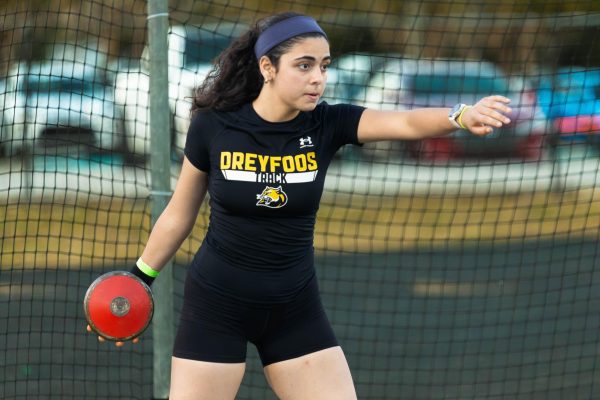
Shifting away from running and relaying to the field events, the discus throw event does not test speed nor endurance, but strength. The event has competitors vying to see who can throw a disc, weighing 1.6 kilograms (kg) for boys and 1.0 kg for girls, the farthest distance.
“Despite (the discus) being small and light, it’s easily underestimated,” band junior Hinav Kour Ahmad said. “Its structure makes it challenging to throw as it can be technical, requiring balance and full alignment.”
At meets, each competitor is given three throw attempts. The judges score and count their farthest throw to determine the results. Competitors must stay in a circled, designated area of around 2.50 meters during their throw. The event requires competitors to have a straight wrist and hand alignment, a firm grip on the discus, and a fast spin to maximize momentum during the throw in order to perform well, according to Kour Ahmad.
“Even a slight misalignment in your wrist or hand caps the amount of strength and momentum that the disc actually travels with,” Kour Ahmad said.
While each event tests a different skillset, they all provide competitors the chance to reflect on their past performances and results, in order to improve for future competitions.
“Competing in a sport where the result depends solely on you, leads to you encountering moments where you wished you performed better, but didn’t,” Kour Ahmad said. “(Track) has taught me to gracefully deal with losses and forced me to stop continually comparing myself to others.”