
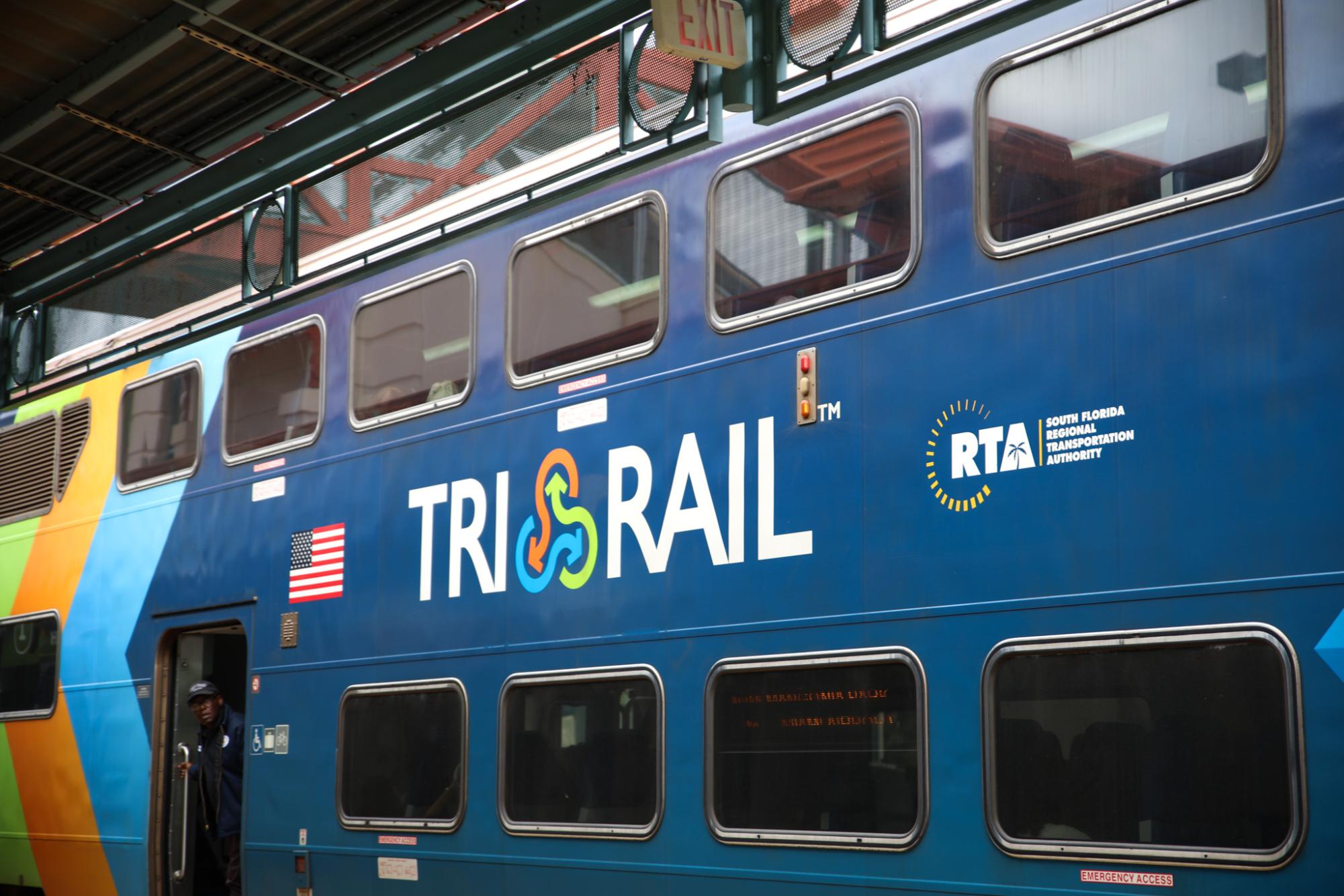


Tri-Rail, a 72-mile rail commuter system with stations located throughout Palm Beach, Broward, and Miami-Dade counties, has received at least $42.1 million annually from the Florida Department of Transportation (FDOT) since 2014. Tri-Rail uses these funds to upkeep 19 stations, maintain 50 rail cars, and over a dozen trains. However, in Fiscal Year (FY) 2027, which begins Oct. 1, 2026, the state government is projected to provide just $15 million, a funding cut of $27.1 million.
The South Florida Regional Transportation Authority (SFRTA), which operates Tri-Rail, has said the system can continue running with reserve funds until July 2027. After that, Tri-Rail would face a likely shutdown, according to WPTV. SFRTA officials claim that a long-term funding solution will be necessary to maintain service beyond that point.
“The trains have to run on time, the trains have to be clean, (and) there’s got to be enough room for everybody,” SFRTA’s Director of Public Affairs Victor Garcia said. “All those things, which are the issue of our funding, we are just trying to keep running so we can get to that place where we can actually get better and buy new equipment.”
In February, the Florida House of Representatives passed a bill to restore the previously required $42.1 million in annual funding for Tri-Rail. However, the Florida Senate has yet to pass the bill. In fact, the legislative session, which was scheduled to end March 13, has been extended due to disagreements between the two legislative chambers. Governor Ron DeSantis typically signs the final state budget for the upcoming fiscal year in June.
“Right now, there’s been no movement in the Senate,” said Mack Bernard, Florida State Senator from the 24th district, which is located in Palm Beach County. “We’re still stuck in the budget discussions so we’re supposed to go in a special session to craft the budget. However, between both the House and the Senate, the leadership has not agreed on allocations.”
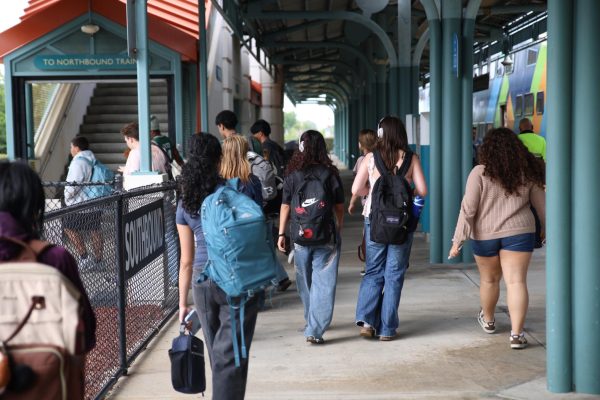
352 students out of 1345 currently use the Tri-Rail to come to school, according to assistant principal Drew Dawson. The School District of Palm Beach County (SDPBC) has provided Tri-Rail transportation options to magnet schools since 1990, according to Sun Sentinel.
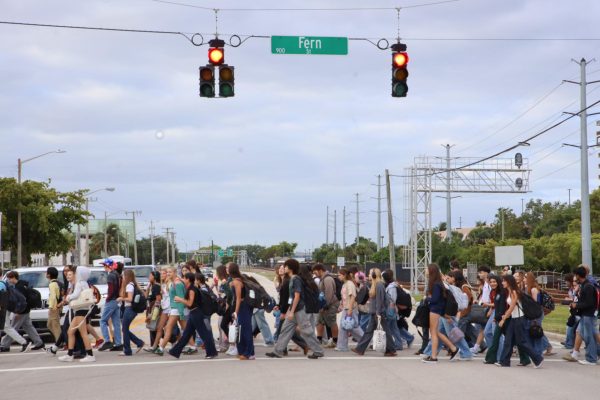
“Unless the district is able to accommodate by increasing their own funding in regards to transportation, then we’re going to have almost a (fourth) of our student body that’s not going to have a method of transportation to come to school,” Mr. Dawson said. “That could limit the talent coming to Dreyfoos and the opportunity that kids in south (Palm Beach County) receive.”
For digital arts & photography sophomore Clover Orezzoli, the Tri-Rail provides a way to reach campus every day. She lives in Boca Raton, part of the southern region of Palm Beach County where direct school bus service to Dreyfoos is not available. Aside from driving to school or getting dropped off by someone via car, Tri-Rail is the only option for many students in the south county.
“I honestly don’t even know what I would do if I couldn’t take the train anymore,” Orezzoli said. “My dad could drive me some days, but it would be really hard trying to get to school on time every day. There’s a really good chance I would have to stop coming to Dreyfoos at all.”
Her mother, Nicolette Orezzoli, agrees that the Tri-Rail has made the commute to school manageable for their household. Driving from the Orezzoli household to Dreyfoos even without traffic, she said, takes well over half an hour.
“Her father and I don’t have that kind of time in the morning,” Nicolette said. “One of us would have to change our work schedules and make less money to drive her to school every day. It’s just not a viable option for us.”
Band freshman Hannah Kaminer, like Clover, also relies on Tri-Rail to get to school and return home every day. Kaminer and Clover are both part of the 40.8% of student Tri-Rail riders that are “unsure” if they would still be able to attend Dreyfoos if Tri-Rail no longer existed, according to data collected in a casual survey conducted by The Muse. An additional 11.7% of student riders stated they would have to stop attending Dreyfoos entirely.
“I rely on Tri-Rail because my mom works in Boca Raton and Delray Beach,” Kaminer said. “My retired grandma would maybe be able to drive me sometimes, but getting here every day would be really difficult, maybe even impossible.”
According to Garcia, the drop in funding occurred partially due to the end of federal COVID-19 relief funding. Tri-Rail received at least $265 million through federal legislation such as the Coronavirus Aid, Relief, and Economic Security (CARES) Act and the American Rescue Plan Act of 2021. This additional COVID-19 relief funding was granted to keep Tri-Rail afloat during the pandemic as ridership numbers plummeted from 4.4 million riders in 2019 to 1.3 million riders in 2020.
“It was a big shocker,” Garcia said. “The part of where we were getting our monies from, (the part) that the Florida Department of Transportation had been giving to us, that dock step was removed.”

To address the millions of funding lost, the FDOT has requested that Palm Beach, Broward, and Miami-Dade counties contribute additional funding to sustain Tri-Rail operations. Each county currently contributes approximately $4.2 million annually, and the state has requested that each county increase their contribution by $10 million annually. This would be an additional $30 million in county funding for Tri-Rail, which would completely offset the reduction in state funding. Vice Mayor of Palm Beach County Marci Woodward was reached out to for comment, but no response was received.
“The counties have limited budgets,” Senator Bernard, whose district is located within Palm Beach County, said. “I’m sure the counties can add some piece to it (the Tri-Rail funding). But I don’t think that the counties will be able to completely share the burden.”
71.3% of student riders, including Clover and Kaminer, feel that the Palm Beach County School District or local government has a responsibility to maintain Tri-Rail if funding is cut at the state level.
“I really don’t think students and families were considered at all when the state made this decision,” Clover said. “But, if they don’t restore the funding, the county or school district needs to. Too many students rely on Tri-Rail to get here every day. Getting rid of Tri-Rail over stupid budget disputes would be leaving students out to dry.”
SFRTA has been in negotiations with state legislators to restore funding, and Garcia is optimistic that a deal will be finalized soon. Despite the budget cuts, Tri-Rail surpassed 4.5 million riders in 2025, exceeding its former record of 4.4 million set in 2019, according to the Palm Beach Post.
“I’ll tell you that we’re in a good place,” Garcia said. “From what we’re hearing, it’s all been nothing but support, and everybody has been working to get it restored.”
All details about negotiations between SFRTA and the state legislature are accurate as of April 22, 2026.
Gavin Murray • Apr 23, 2026 at 9:54 pm
Wow! What an informative and well-written story. Great job Cole and Graeme!