

The morning after right-wing political activist and media personality Charlie Kirk was assassinated, American history teacher Jeffrey Stohr was not planning to discuss it in class. Yet as his students milled into the room, abuzz with conversation about the divisive event, he decided to open the floor to discussion.
“The key for me was not to provide a side on it,” Mr. Stohr said. “The vast majority of kids started the conversation with, ‘I wasn’t a Charlie Kirk fan,’ but that’s Dreyfoos. I always feel bad for kids who are here, who are conservative politically, because they’re outnumbered, and they probably feel uncomfortable. I don’t want them to feel that way at all.”
In the end, Mr. Stohr moderated discourse about Charlie Kirk’s death in all five of his classes over the course of two days, and said he “got kind of emotional” every time. The discussions held within the poster-covered walls of Mr. Stohr’s classroom serve as just one example of a larger pattern amongst students on campus as political issues become topics of social conversations. According to a casual survey conducted by The Muse, 62.4% of students said they agree or strongly agree that they feel comfortable being open about their political views with their friends .
In the wake of Kirk’s assassination, theatre freshman Marcus Seac, who said he identifies as liberal, posted a quote of Kirk’s on his Snapchat story. The quote read: “I think it’s worth (it) to have a cost of, unfortunately, some gun deaths every single year, so that we can have the Second Amendment to protect our other God given rights.”
Another freshman responded to the post in a private chat, sent another quote by Kirk, and said that it would “behoove” Seac to “do some research before cherry picking” Kirk’s statements. The response sparked a heated debate between the two students.
“I was told I need to go back to my country since clearly I don’t like this country,” Seac, who was born in America but lived in Haiti until he was four, said.
A 2023 Pew Research Center study found that when asked to describe politics in the United States these days in a single word, a majority of Americans (79%) expressed a negative sentiment. The most popular choice? “Divisive.” In light of this, as well as broader national discourse surrounding the future of party polarization in America, Mr. Stohr said he hopes the generation he teaches will be “braver than his generation has been” when it comes to standing up for themselves.
“Very few teachers on campus talked about (Charlie Kirk’s assassination) after the day, because they were so afraid of some kind of retribution,” Mr. Stohr said, his voice breaking. “It’s like the opposite of what we stand for. It’s an idea that we’re supposed to have an open forum in this country, (and) it’s like we can’t do that. I always tell them (the students), nobody is going to leave here thinking that their 11th-grade history teacher thought everything was just normal the way we were going.”
Visual freshman Kayla Desauguste, who said she identifies as liberal, discusses current events in English class with peers and “it somehow always leads back to Charlie Kirk.” After sharing with peers that she did not feel “mournful” for him because, as an African American, she does not think Kirk would have felt that way if she suffered his fate, Desauguste was called “cruel.”
“I think that, especially at an art school where everybody’s different, political views have become more important,” Desauguste said. “This is the school where we’re all supposed to be kind to each other, be friends, think before we speak, but because of the times we’re in now, it’s become harder for everybody to get along.”
The same survey by The Muse found a juxtaposition in the importance of politics to students. While 49.8% of students feel politics are of “quite a bit” or “extreme” importance, an additional 41.6% found that politics are “somewhat” or “a little” important.
For some students, even if they do not discuss politics with peers on campus, they learn more about their classmates’ views from social media. Communications senior Margaret Toner, who identifies as “very liberal,” said she “cut off” a friend after seeing their Instagram note expressing satisfaction that the 2024 Florida Amendment Four, Right to Abortion Initiative failed to pass.
“I just told them, I’m not comfortable with what you believe in, because a lot of it was moral,” Toner said. “It wasn’t even political stuff. I don’t really care about what you think about the economy, but it was moral stuff and equality…, I can’t associate myself with that because I don’t want people to think that it’s what I am.”
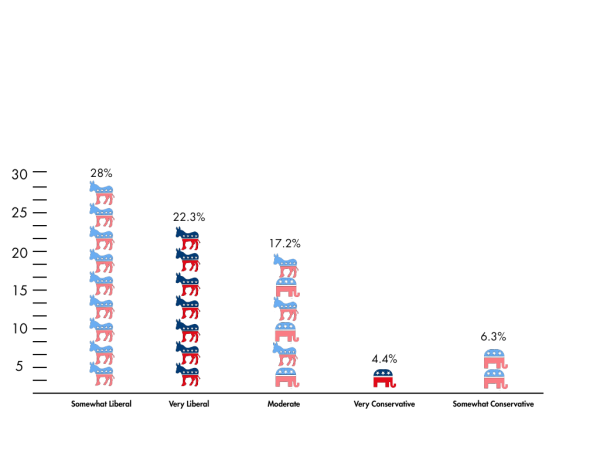
Visual senior Alessio Bangs Quesada said his conservative views, which have been heavily influenced by his Catholic faith, haven’t “gotten in the way” of his being able to maintain friendships with people from all different backgrounds. The Muse survey found that 57.4% of students feel their political views have not affected friendships at all.
“Most people would disagree with me on my opinions, and of course I’m going to respect that,” Bangs Quesada said. “But I don’t really see it getting in the way of any friendships. It never has, and I’m actually really proud of my friends for that.”
For Bangs Quesada, daily conversations on the bus with a liberal friend gave him insight into opposing views. Bangs Quesada said the conversations always ended in a “respectful stalemate,” as neither could convince the other.
On the other hand, digital arts and photography junior Ben Bagatell said his conservative beliefs, mostly concerning his support for the state of Israel, have led to him feeling judged by others on campus “all the time.” Once, after posting a video on his Instagram story in support of Israel after the Oct. 7, 2023, Hamas terrorist attack, another student responded in strong disagreement.
“I was just so shocked,” Bagatell said. “And then I realized I don’t really agree with the left as much as I thought I did.”
While The Muse survey found 28.1% of students avoid talking about politics with classmates because they are worried about how they’d react, Bagatell said he sees himself as an “open book.” Despite this, he said he feels other students have misconceptions of his views, impacting his comfortability around them.
“I wish people could understand not just about me, but conservatives, that not every single conservative agrees with every single thing Trump does,” Bagatell said. “There’s a difference between the MAGA (Make America Great Again) movement and your average conservative individual. There’s a huge difference.”
Some teachers, like Stohr, have witnessed such misunderstandings lead to conflict in classroom settings.
“This is beyond conservative and liberal,” Mr. Stohr said. “It’s not even that anymore now. There’s a certain amount of meanness in it.”
Band junior Stephen Carr, who identifies as a Republican, said he also believes students having to interact with each other regardless of beliefs has prevented polarization on campus. Personally, Carr said his political views have never affected who he feels comfortable around because he “tries not to think about that” when it comes to friendships.
“The best thing anyone could do is make sure that they’re constantly surrounded by people who both agree with and oppose their beliefs,” Carr said. “So they’re not constantly talking to people who just agree with what they say.”
For band junior Jack Capps, who said he identifies as leftist (which he described as more “intense” in its views than liberalism), his participation in music ensembles has influenced his belief that political views do not have a major impact on how students interact on campus.
“In the top jazz band here at Dreyfoos, we all have different political views, and you can see that through social media and what they post on their Instagram or Snapchat or wherever, but you don’t confront them about it,” Capps said. “(It’s) not because you’re trying to be passive, it’s so you can have the betterment of the group and have that community among each other.”