


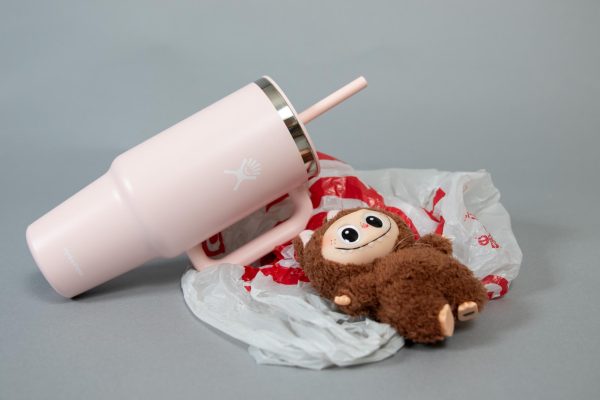
Walking through the hallway, the latest online trends can be seen. A blue Labubu, a $70 plush based on storybook characters created by Kasing Lung, swinging from a backpack. A junior with a limited edition Summer Fridays lip balm with a price tag of $24 attached for half an ounce of product, in hand. A purple Owala water bottle sticking out of a freshman’s bag, with a mismatched lid so it matches their favorite Disney Princess’s dress.
Shopping carts are filled with trinkets and accessories driven by online trends and markets. Overconsumption, as described by the Oxford English Dictionary, is the action of consuming something to an excess. This term has experienced a rise in usage as more individuals recognize the cyclical purchase and discard pattern of throwaway items, often in sync with the rise and fall of new trends perpetuated by social media.
TRENDS
LABUBU:
The Labubu, a small stuffed animal attached to a keychain, was first created in 2015 but did not receive widespread popularity until 2024, after being endorsed by a member of the K-pop group BLACKPINK, Lisa. The “Monster Series,” a mini collectible series within the brand, generated $677 million in 2025 alone.
“I have found myself buying a Labubu,” vocal sophomore Jarrod Bryant said. “There was a YouTuber I used to watch, FaZe Rug, and he bought a bunch.”
OWALA:
Owala water bottles, first sold in stores in March 2020, experienced a spike in popularity in late 2023, with the main selling point being their “FreeSip lid” and wide range of colors. The hashtag #owala has been viewed on TikTok over 272 million times. As a result, between January and August of 2024, the brand had a 200% increase in revenue.
“They (people who purchase these items) tend to take influence from people who are older than them or people on social media that they follow or look up to,” visual freshman Sienna Wright said. “They tend to copy those actions.”
A casual study conducted by The Muse found that 94.6% of student responders believe overconsumption is influenced by TikTok, 63.4% believe it is influenced by Instagram, and 82.9% attribute its influence to celebrity influence. Social media plays multiple roles in the steady demand for these items, often through targeted advertisements, fueling people to create comparisons between themselves and individuals they find online.
CAUSES
Dopamine, a hormone that transmits signals to the brain, is released in anticipation of a reward. A study cited by Psychology Today found that dopamine is known to increase during shopping, with online purchases resulting in a more significant spike in dopamine compared to in-person ones.
The psychology field of neuroeconomics has been researching brain processes in relation to economic decision-making. Neuroeconomist Uma Karmarkar explains that the brain is “figuratively always browsing the aisles” whenever we see an item. For decades, brains would grasp onto items seen in advertisements and media; however, today’s short-term media has become sought after by consumers, exposing individuals to more stimulating products in a quicker manner.
“There are more things to overconsume and more ways to do it,” AP Pyschology teacher Danielle Edwards said. “There are many places you can buy and very few places where you are not a customer.”
EFFECTS
“Now you see people with things different from what you have (when using social media platforms),” Mrs. Edwards said. “‘I don’t have them, and that stinks, so I should go and buy them. I won’t be happy without them.’”
This concept is known as social comparison, the idea that people decide their own worth based on others. Research from psychologists Amy Summerville and Neal J. Roese asserts 12% of our daily thoughts are consumed by comparisons to people around us. The Relative Deprivation Theory is a similar concept, presenting the social tendency of an individual, when comparing their materialistic possessions to those who have more, to experience feelings of injustice, frustration, and discontent because they don’t meet the “standard.”
These effects on the brain cause consumers to fall victim to purchasing a multitude of items that may not have originally stood out to them, but which have absorbed their attention through the influence of social media.
“I think that everything (overconsumed items) will be everywhere, and no one will be their own self,” Bryant said. “Everyone’s buying the same exact thing and not going for originality.”
One way to not fall victim to the temptations of overconsumption is to keep oneself aware of them. Massachusetts Office of Consumer Affairs and Business Regulation suggests paying attention to the market strategies larger companies are using.
“The way we get around (overconsumption) is by being aware of how our brain and mind feel when we buy something,” Mrs. Edwards said. “That we don’t need that quick dopamine rush.”